Boa is proud to present our roundup of book reviews from the Spring 2026 season thus far. Check out the reviews below to see what people are saying about Boa’s talented authors!
This Elegance by Derrick Austin
“Get back to the word,” by Michael Colbert
From the article: “This Elegance is a collection that’s full of life. With attention to dreams, tarot, and the places the mind travels, these poems contemplate divinity, eroticism, and a life lived through art across time.”
“’Common as the Blues’: Queer Futurity and Pastoral Optimism in Derrick Austin’s This Elegance,” West Trade Review
From the review: “Writing into a world shaped by racial violence, queer precarity, pandemic disorientation, and the ongoing pressures of labor and spiritual uncertainty, Austin locates beauty not apart from these conditions but within them.”
“REVIEW: This Elegance by Derrick Austin,” by Madelyn Parker
From the review: “As Austin muses on his own paintings and his homage to others, the different voices whether painter, singer, or drag queen become just as much a part of the underpainting of This Elegance as do Austin’s verses on joy, love and sensuality, or loss and violence and pain.”
August, September, October by Craig Morgan Teicher
“Briefly Noted,” The New Yorker
From the review: “As Teicher considers aging, parenthood, marriage, and memory, he meditates on the relationship between time and the forms that capture it: the sonnet seeking to memorialize a moment, or the diary that is a record of its own incompleteness.”
“August, September, October,” Publishers Weekly
From the review: “Beauty and the dark undertow of suffering are skillfully woven throughout the diaristic and companionable latest from Teicher.”
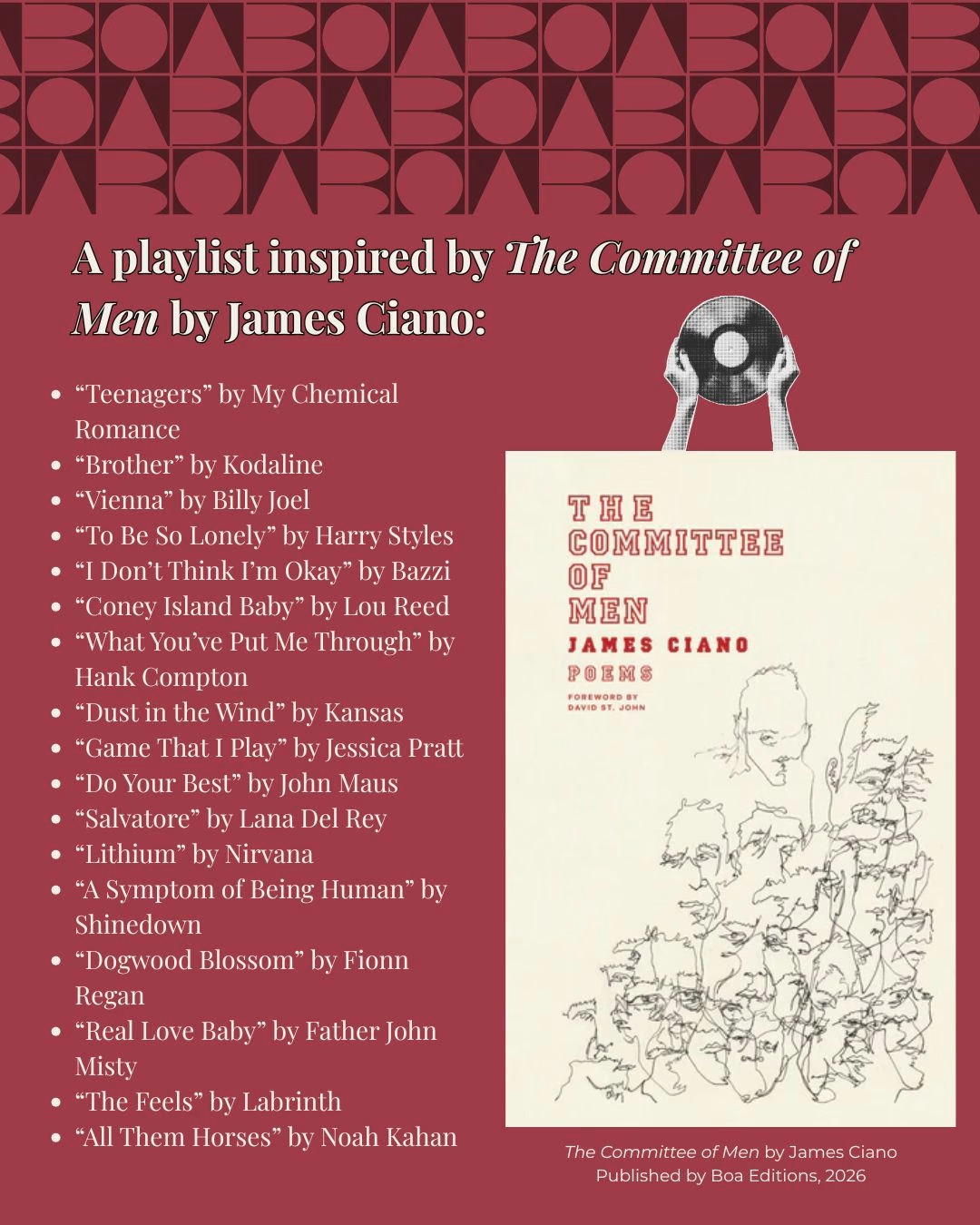
The Committee of Men by James Ciano
“James Ciano by Bobby Elliott,” BOMB Magazine
From the article: “It’s exceedingly rare, though, to find poets I can truly call my own─poets whose work reminds me of what I crave most on the page, and what I set out to bring to it when I sit down to write: the language of the everyday pitched to the urgency and ephemerality of our lives. James Ciano is one of those poets.”
“The Committee of Men, BOA Editions (April, 2026),” Preposition
From the review: “Likewise, to characterize the rendition of white, middle-class masculinity in Ciano’s debut as ‘performative’—’Sack taps in the shower. / Rat-tailed towels snapped back // across a stomach’—would be to dismiss with TikTok breeziness what is in fact a layered, psychologically complex portrait of the adolescent American male.”
At the Gate: Uncollected Poems 1987-2010 by Lucille Clifton
“Reflections on At the Gate: Uncollected Poems 1987-2010 by Lucille Clifton,” by Mariahadessa Ekere Tallie
From the review: “At the Gate is an exciting collection because it lets us see Clifton in process and it allows us to see the ways that she insisted on bearing witness while admitting that it is at times ‘terrifying’ to see.”
“At the Gate: Uncollected Poems 1987-2010,” RHINO Reviews
From the review: “I felt like I was eavesdropping as I read At the Gate, a posthumous edition of the poems Lucille Clifton left in her computer hard drives and laptop, as well as other electronic materials and word processor diskettes. These are poems she chose not to include in her published collections, the kind of work that we writers share with our critique groups and our families but not with a wider audience. For someone who has loved Lucille Clifton’s poetry for most of my life, it was a rare privilege.”
“A new posthumous collection adds dimensions to poet Lucille Clifton’s profound catalog,” City Magazine
From the review: “Just as Clifton’s relationship with Boa is its own historical document, Clifton’s verse throughout her career tended to evoke history, like the lineage of family. There’s Aunt Timmie, whose labor ironing the bedsheets of a “master poet” is also art. There’s her father, Samuel Sayles, who built railway couplers.”
Kazim Ali Named OnlyPoets Poet of the Week
“Kazim Ali,” ONLY POEMS
From the profile: “Kazim Ali coined the term ‘genre-queer’ to refer to literature that blurs the line between poetry, fiction, and nonfiction.”
Splashed Things by Leigh Lucas
“Seven Elegiac Books Recommended by Leigh Lucas,” Debutiful
From the article: “The elegy is as old as literature itself, but the form has been reinvented again and again in our attempt to make meaning of loss, honor the deceased, and to get as close as we can to conveying the experience of grief─something that thousands of years later remains out of our grasp, just beyond the reaches of language.”
“The First Book: Leigh Lucas,” The Rumpus
From the interview: “My writing process does not have any readers in mind, which is a good thing because I would never have written most of the poems I have if I was focused on what people might think of me. This separation between the creative process and the publishing process has allowed me to be really unselfconscious and honest in my work, and I hope I can maintain that separation forever.”
“In Their Own Words,” PSA
From the article: “Somehow, in the absence of familiar constraints─line breaks, stanzas, titles─a whole book came pouring out. I couldn’t hide behind the flourishes of traditional poetry, so I put the language to work, and let sound, tone, the sensory, even humor, sometimes, guide me.”
“INTERVIEW: Leigh Lucas (Splashed Things),” The Racket
From the interview: “Forming a candid, prismatic exploration of loss, love, and living on, these poems look at the tragedy from many, often unexpected angles.”
Compiled by Elena Garcia, Boa summer ’26 intern