
BOA: How did you get started as a writer?
Mosteirin: As a kid I was always reading and writing. I filled up notebooks with poems and stories and sketches. I remember when I got my first computer, which was a huge, old Texas Instruments desktop monster (a cast-off from my father’s office) and I didn’t want to play video games or chat, I wanted to use the word processor. I loved seeing my words on the screen. I loved opening up a fresh doc and giving it a title. Oh, how I agonized over those titles! I could go on about this first computer, but if I did that, I don’t think I’d truly answer the question.
My first real publication is probably part of the answer. I wrote a chapbook that was selected by Lydia Davis for the Kore Press Short Fiction award. That’s a big part of how I got started, professionally. But of course, I was really unprofessional about it. I was one year out of undergrad at that time and had no idea how to support the chapbook, mostly because I was trying to figure out how to pay rent, so the great honor of having my work selected by Lydia Davis was more or less lost on me.
To support the chapbook, I did a handful of local readings, one of which was attended by J.D. Salinger (in New Hampshire) who gave me negative feedback. I was crushed. After that, I did yoga teacher training and taught yoga to incarcerated women. I thought it was a turn away from writing, but there was no way I could stop writing. The writing happened no matter what.
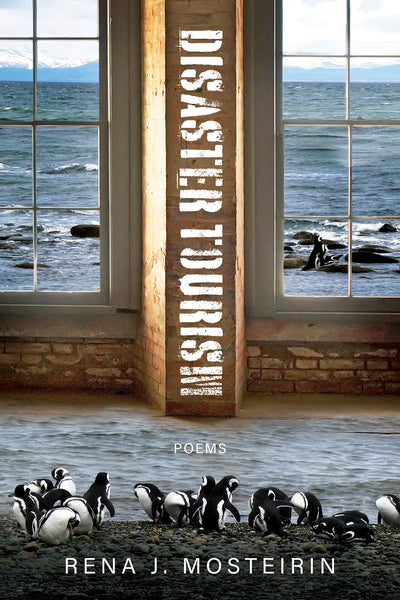
B: The work in Disaster Tourism is a huge departure from your work in Experiment 116. Can you talk a little bit about how these two very different books came about?
M: Experiment 116 is a project book of poems that are computer-generated, with an essay and a bit of code. I took Shakespeare’s Sonnet 116 and put it though Google Translate in pairs and trios until all the languages in Google Translate were used, and all the output poems had different first lines. I did this for fun, but the output poems were strange and wonderful and supported these ideas I was formulating in graduate school about translation and non-standard language use. I think of it as computationally-based experimental poetry.
As I was working on that book I was also writing and publishing the lyric poetry in Disaster Tourism. It took me about twenty years to write all the poems in Disaster Tourism. Some were written in undergraduate poetry workshops. One was even in my college lit mag. Isn’t that crazy? Students cringe when I tell them this, but it’s true! You write and write and write. You place a poem here, a poem there, the years pile up. Bit by bit you’re building a poetry collection.
A collection asks for a different quality of attention from the reader. Each poem is its own scene, in its own moment. Reading a project book, like Experiment 116, you can sit down and read it from start to finish, the poems, then the essay, then the code, and you are meant to understand something. Disaster Tourism is like a collection of doorways into many different varieties of experience.
B: Can you talk a little bit about your MFA experience?
M: Sure. I went to grad school kind of late. In my first term at Bennington, it was 2016 and I was, what, thirty-four years old? I’d been writing and reading for a very long time. It was a huge advantage to come into the MFA at that point in my life. I’d had a lot of experience working outside of academia. I’d had so much time to read and write and think.
Getting the MFA was a way of professionalizing as a writer. From there I was ready to push more deeply into getting my work published and also become a teacher. My teachers at Dartmouth, when I was in undergrad, were wonderful, but I needed new models for teaching and fresh ideas about teaching. At Bennington, my workshop leaders were very different and presented me with options, letting me create my own teaching style by picking and choosing what I saw working best in workshop. There’s also a huge focus on reading at Bennington, and that’s stuck with me. I’m always, always reading.
B: That leads me to my next question, how did you come to own a bookstore?
M: I took over Left Bank Books during the pandemic. Left Bank is a small, used bookstore in Hanover, New Hampshire. I was already teaching poetry workshops to grad students when the pandemic hit and I was really scared that the town would lose our small shops, as everyone was buying everything online during the pandemic. Keeping the used bookstore in town open seemed critically important because used bookstores represent decades of different ideas and decisions made by writers and publishers. This is important for the culture of the written word. New bookstores are much more limited, what they sell is dictated by current market forces. Used bookstores are all about serendipity, the work you find there can be more risky, and also the scope of ideas is really broad. That’s so appealing to me, as a thinker.
B: Finally, you’ve co-authored two books with James E. Dobson. How does the process of writing a book collaboratively inform the process of writing a book on your own?
M: I guess I want to trouble that idea a little bit and say we’re never really writing books on our own. There are teachers, first of all, whose voices never truly leave our heads, then we have our writing groups, our friends who are writers, we get feedback from agents and editors, whose philosophies can make a huge mark on the text in the revision process, and then I think the books we’re reading as we write can also inform what appears on the page. So I don’t really think I’ve ever written a book “on my own” and I don’t think that’s how art works, generally.
I like to write with James E. Dobson because he has a very academic approach where I have a poetic approach. We will come to the same ideas in very different ways. When we began talking about the ideas that became our two co-authored books Moonbit (punctum, 2019) and Perceptron (punctum, 2024) the interesting thing was how differently we were reading the same material. I think his critical readings broaden my perspective and my poetics give our projects more depth. Also, we’re married, and in our day-to-day lives we’re always talking about ideas. We’ve been together for eighteen years. In my opinion, a good marriage is built on thinking interesting thoughts, together.