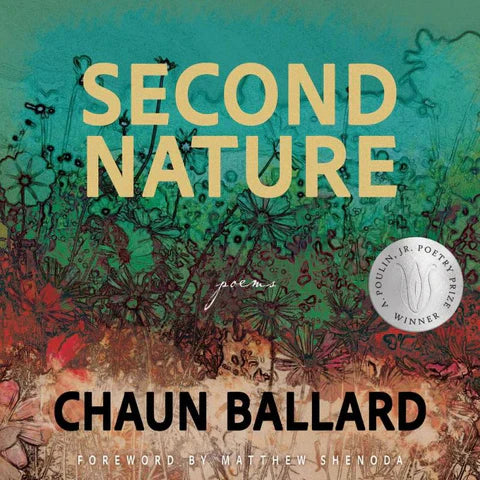
The first thing I notice about Chaun Ballard’s Second Nature is how formally ambitious it is—the first poem, “A Poem Ending with a Strambotto wherein I Include an Extra Line That Is Myself or A Poem in which I Name the Flower,” shows that this is a collection that will not hold back, both in subject matter and in structure, packing each poem with evocative phrases housed in thoughtfully constructed lines. As I keep reading, though, I realize I don’t actually know what to expect—other poems are presented as sonnets, erasures, and even an abecedarian, inviting readers to pay close attention as they figure out how to read each layered piece. I am stunned by Ballard’s eagerness to experiment with structure; his range is impressive, but I don’t get the sense that these stylistically complex poems are simply tricks: instead, these poems are playgrounds, constructed by Ballard to create space for his inventive, emotive phrases to move and explore.
Even Ballard’s titles offer more than I have come to expect from titles; some contain whole stories, like “The Ghost of My Grandmother Looks Out over a Baseball Diamond and Tells Her Daughter about a Man Coming Home,” which is vivid enough to ensure that we’re listening, even before Ballard captivates us with “Sometimes you can see a season / bruisin’ through an evenin’ cloud.”
The playfulness in Ballard’s work is evident, despite its often heavy subject matter. In “Q & A,” he poses the question “Why do black people run from the police?” and responds: “The concrete is hot. These are new shoes.” Throughout his collection, Ballard discusses subjects including racism, police brutality, and fraught family dynamics with a balance of earnestness and wit, refusing to limit himself to a single kind of communication. This unlimited quality appears throughout the book: Ballard includes poems from multiple perspectives, including the ghosts of Frederick Douglass, W.E.B. Du Bois, and the musician Johnnie Taylor.

One of my favorite poems in this collection, “Today,” stands out at first because of its serious, more muted tone. In this piece, Ballard sets a painful scene: “My father sits on a sofa not his own / in a home not his own / watching a television that is not his,” describing a father “Who is frail / Has not been well for months.” Throughout the prose poem, Ballard separates phrases with slashes, halting the momentum of the piece like the speaker is forcing himself to take a few steps forward at a time to face the difficulty of his father’s declining health. The speaker tells us “I don’t want to ask / how long he will survive,” but his reluctance doesn’t stop him from digging into a vivid memory: “Just the other day / it seems / I was under the hood of my first car / (a green Ford escort / given to me by a man who is like my father / but is not my father).”
In this poem, readers can feel the distance between the speaker and his father, both in phrases like “This is the most we have spoken in years” and in the way Ballard brilliantly slows the pace of the poem through its structure. He resists sentimentality, ending with “I ask him / How are you doing? / & my father / is always / 60 degrees.” This perfect ending image, cool and evocative, is one of many precise descriptions that invite readers to see through Ballard’s poetic lens.
The final poem in the collection, “Q &A,” ends by offering one more perfect image:
—What do you hope to accomplish by writing these poems?
I hope to release a hummingbird from the palm of my hand.
Watch it fly off on little wings.
This bravery—to send a set of poems out into the world, especially one so richly textured as Second Nature, is what I admire most about Ballard’s work, and what I imagine will keep images like this hummingbird fluttering around in readers’ minds.
Sarah Peace is an intern at Boa Editions. She holds an MFA in poetry from UC Irvine. She has taught writing courses at John Carroll University, Cleveland State University, and elsewhere.