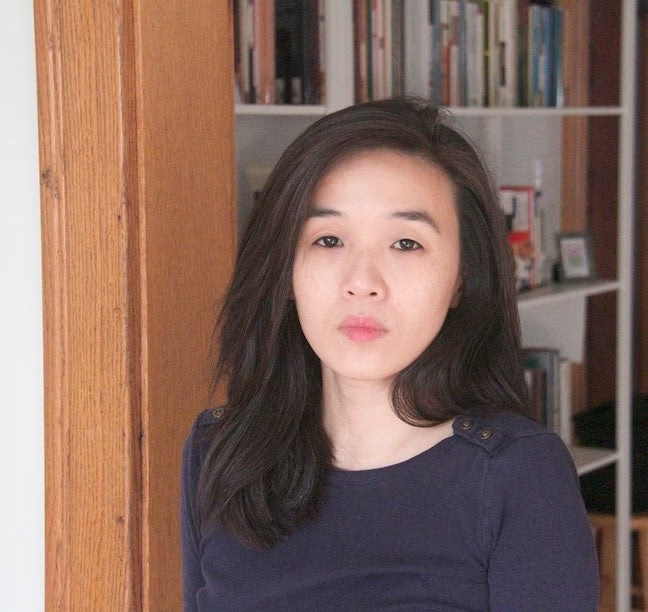
Willie Lin was born in Beijing, China and lives and works in Chicago, IL. Her poems have appeared in Bennington Review, Prairie Schooner, and The Threepenny Review, among other journals. She’s the author of the chapbooks Lesser Bird of Paradise (MIEL) and Instructions for Folding (Northwestern University Press), winner of the Drinking Gourd Chapbook Poetry Prize, and has received fellowship and scholarship support from Kundiman and the Summer Workshop Program at the Fine Arts Work Center.
In the following self-interview with Willie Lin, learn more about the author’s thoughts around dislocation, the pastoral, and grief!
This book speaks to, in part, a sort of lived-through dislocation: from family, from history, from physical place, even from self. And yet many of the voices in these poems have a strong sense of self. Do you find that being or feeling out of place sharpens one’s sense of identity or resolve?
I was born in Beijing and lived there until I moved to the U.S. at the age of nine. Afterwards, I still spent a lot of my childhood traveling back and forth, spending some summer and winter breaks in China. And I think there is a way in which feeling lost or out of place—as I have often, since then, feeling like a visitor to a life in each place—that brings questions of identity and self to the forefront. For example, I remember a family member in Beijing saying in wonder that I’d become a different person after a couple years away. Specifically, that I’d become quiet and reserved. Who knows how much of that change was a just young person growing into self-consciousness and how much of it was learning to be in midst of that sense of lostness? What had surprised me most about what he’d said was that this transformation in me had happened without my recognizing it. Until then, I didn’t know I was capable of that kind of change. I didn’t know that I had a self that could be lost. In a way, in my poems, I’m still learning to speak as plainly as I can out of that quietness and estrangement.
Nature, in this book, is both beautiful and uncaring, a salve for the wounded spirit and also cold and mechanical. Do you think of nature as a healing force? Or is it more complex than that?
I think encountering the natural world draws us outside of ourselves. The sparrows that chattered on the white pine that was outside of my window. They were calling, not to me, but still they reached me and transported me to where they were.
In her book On Beauty and Being Just, Elaine Scarry argues that beauty is a life-affirming pact. It calls us to attention and reverence and teaches us to extend that regard laterally, to the wider world. So often, my own tendency is look inward and down, as if I’m afraid to lift my head and incapable of seeing the world in full, living and navigating only by edges and shadows. Nature and its beauty has had for me the effect that Scarry describes—it’s a force that decenters and moves me to pay attention and be receptive to what exists not for or because of us but alongside us.
What draws you to grief, as a writer? An interest that can be seen, for example, in the lines, “When you read, you are full / of someone else’s sadness.” What does studying the grief of others tell us about ourselves?
Things often seem to loom larger in their absence than in their presence. I find that sharing in grief in writing and reading is a way to come to term with loss and begins to make it bearable. In that sense, grief seems inseparable from the search for meaning. Lucie Brock-Broido had a theory that are two kinds of poems—those that beckon and say, “listen, you too have felt this way,” and those that say, “listen, you have never felt like this.” Either way, we’re enlarged by that gesture of the poem, as reader and as writer. Poems that address grief and loss, familiar and unfamiliar, allow us to hold in mind what is otherwise quicksilver, implacable, irresolvable.